Cultivating Connection in Your Marriage (Part 3): Making Life Dreams Come True
In past blog posts, I have covered the first five levels of the Gottman Sound Relationship House. Once you've learned how to Build Love Maps (i.e., putting effort into knowing your partner's world), Share Fondness and Admiration, Turn Towards One Another, and Manage Conflict, you have a solid foundation from which you can build a vision and purpose for the relationship.
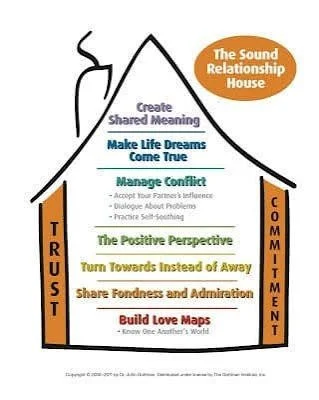
In this part of the Cultivating Connection in Your Marriage series, I will focus on Making Life Dreams Come True. The first four levels of the house must be reasonably sound before addressing this one. You will naturally want to know the dreams of your partner if you have a strong friendship, are fond of them, and feel generally positive about the relationship. Now, let’s talk about what Making Life Dreams Come True actually means:
Making Life Dreams Come True: Knowing Your Partner’s Desires and Becoming Their Ally
Many people have an unspoken fear whenever they enter marriage: What if committing to this person means giving up my own dreams? While marriage certainly requires willing sacrifice, the Gottmans built an entire principle of their Sound Relationship House around addressing this fear and helping couples prevent an unconscious or unwilling sacrifice of their life dreams.
Examples of a "Life Dream"
In Gottman terms, a life dream isn't necessarily a grand ambition. It can be:
A career direction or creative pursuit
A desire about where to live, or how to live
A value inherited from childhood that a person wants to honor
An unfulfilled goal — learning an instrument, running a marathon, writing a book
A vision of the kind of parent, sibling, or friend someone wants to be
Even something as simple as wanting more solitude, more adventure, or more stillness
Often, these dreams stay hidden. It takes a lot of vulnerability and self-awareness to tell your partner explicitly, “This really matters to me”. More often, it’s mentioned in a small way, a passing comment, or even a passive-aggressive critique. When this happens over a long period of time, a relationship can accumulate a mass of unspoken dreams that can rot into resentment. Not only that, but it can also be the fuel for gridlocked conflict.

My husband’s unfulfilled goal this year is to finish building our backyard fence. The man in the picture is not my husband.
Why This Principle Exists
In their extensive research on couples’ conflicts, the Gottmans found that 69% of conflicts are “unresolvable”, indicating a perpetual disagreement rooted in fundamental differences in personality, values, or lifestyle needs that will never entirely go away. There is actually a lot of freedom here— you don’t have to spend your energy trying to convince your partner to agree with you; instead, the way forward is to be actively curious about your partner’s, and your own, dreams hidden within the unresolvable conflict. From here, you become an ally with your partner’s dreams. The alternative is to be a barrier; when someone feels a partner is standing between them and something that matters to their identity (the “dream”), the relationship starts to feel like an obstacle instead of a home base. Resentment builds even when nobody can quite name what's wrong.
A couple’s typical argument about taking a road trip may never actually resolve, no matter how often they talk about it. The wife seems to always want to get away for a short trip, and her husband is a self-proclaimed “homebody”. The superficial argument is rarely the real issue; hidden within the fight about a weekend road trip might be one partner’s longing for fun and reprieve from everyday life, and the other partner’s longing for stability and slowness. Both are good and valid, but if the couple cannot articulate these things, they will keep spinning their wheels.
Making Life Dreams Come True helps couples become unstuck. Instead of two people quietly negotiating around unspoken longings, it asks couples to do the harder, more generous thing: find out what your partner actually wants out of life, and become an active participant in getting them there — even when it requires sacrifice.

A personal dream of mine: To complete an Ironman!
This may or may not need to be scaled down dream…
Be a “Dream catcher”
Ask, honestly and specifically.
Not "are you happy?" but "what's something you've wanted for years that you haven't told me you still want?" Often, dreams are revealed when someone feels safe enough to say something that sounds impractical, selfish, or unfinished.
Take the dream seriously, even the small ones.
As you listen, don’t first focus on how “practical” the dream is to achieve; the most important part of this is to witness your partner’s dream, whether it be going back to school at 45 or learning how to surf. Be accepting, not dismissive, to create a safe environment.
Look for the honorable purpose underneath.
If the dream does seem difficult or impractical to achieve, be listening for what the dream symbolizes, even if the actual version of it can’t happen. There’s a lot of freedom here! You are not responsible for making your partner’s dreams come true. By being a curious, loving partner, you can help them decode what their dream represents. A partner who wants to live in Aruba might be craving novelty, freedom, and time away from a role that feels too rigid. A partner who wants to live near her family might be longing for connection, friendship, and support. Once you understand the need underneath the dream, it is easier to find flexible ways to honor it.
Make room, even partial room.
The dream can’t be realized in its literal form, or on a preferred timeline? That’s okay. Couples who thrive tend to find a way to honor the dream, whether it be scaled down, delayed, or reimagined. You don’t have to shut it down entirely. A dream can be honored without being fully granted.
Revisit dreams over time.
Because people change, our dreams change over time. Allow this to be an ongoing conversation, creating a habit of checking in on a regular basis (for example, at the start of new seasons, during birthday celebrations, etc.).
Why it Matters
Going back to the Sound Relationship House image, you are truly building something when you do this. Notably, you are building a sense in your relationship that your partner is rooting for you and your journey in life. The Gottmans consider this one of the strongest predictors of long-term satisfaction; if you believe, deep down, that your partner is really in this life with you, your relationship can survive anything.
In the end, making life dreams come true isn't about granting all of the wishes. It's about the accumulated effect of a thousand small moments where one partner says, implicitly or explicitly, “Your becoming matters to me as much as mine does.”

Tara Davis-Woodhall and Hunter Woodhall, married and both Olympic athletes, cheer one another on towards their dreams!
Exercises to Try Together
Here are a few concrete ways to put it into practice. Set aside some time on date night (or post-kid’s bedtime) to do one of these this week:
1. The Dream Interview
Set aside 20–30 minutes each, uninterrupted. One person is the "dream catcher," acting primarily as an interviewer and listener; the other is the "dream teller" — then switch roles. The interviewer asks open-ended questions and simply listens, without problem-solving or steering the conversation toward what's realistic (remember what the dream “symbolizes”).
Some starting questions:
"What's something you wanted for yourself before we met that you haven't thought about in a while?"
"If money and time weren't obstacles, what would you want to be doing five years from now?"
"Is there a version of your life you gave up on that you sometimes still think about?"
"What did you love doing as a kid that you don't make time for anymore?"
The interviewer's only job is curiosity. You don’t have to figure out how to “grant” the wish practically quite yet — that comes later.
2. Dream Mapping
On paper or a shared document, each person separately lists 5–10 dreams, ranging from small ("read one book a month") to large ("start my own business"). Then compare lists together.
Look for:
Dreams that overlap or complement each other
Dreams that seem to conflict, and what need might reside behind those conflicts
One dream from each list that could realistically get a small step forward in the next 30 days
This isn't about ranking whose dreams matter more — it's about making the invisible visible, together, on the same page.
3. The Honorable Purpose Conversation
For a dream that feels difficult to support — expensive, time-consuming, disruptive, or simply unfamiliar — try this structured version of the conversation.
The dreaming partner explains:
What the dream actually is, in concrete terms
Why it matters to them — the feeling or value underneath it (freedom, mastery, connection, legacy, adventure, etc.)
What a "small yes" toward this dream might look like — not the whole dream, just one supportable piece of it.
The other partner's job is to reflect back what they heard before responding with any concerns, and to actively brainstorm at least one way to support even a scaled-down version, rather than leading with reasons it won't work.
4. The Yearly Dream Check-In
Pick a low-stakes, recurring moment — a birthday, an anniversary, New Year's, or simply the same weekend every year — to revisit each person's dreams list from Exercise 2.
Ask:
Which of these dreams still feels alive?
Which have changed or fallen away, and is that okay?
What's one dream, old or new, we could actively support this year?
Treating this as an annual ritual (rather than a one-time deep conversation) is what makes it useful. Dreams shift as life shifts, and a couple that only asks once may be working from an outdated map.
5. Showing You Remember
Between bigger conversations, look for small, low-cost ways to actively support a partner's dream in daily life — sending an article related to their interest, cleaning the kitchen so they have an evening free to work on something, asking a specific follow-up question about a project instead of a generic "how's it going?" These small acts don't replace the larger conversations, but they signal to your partner that their dreams matter, and you haven’t forgotten them.

Build one of these exercises into a birthday tradition!
Ask for help
If these conversations feel heated or stuck, ask for help from a trusted mentor or therapist. Sometimes, people have difficulty accessing their own dreams, let alone sharing them with their partner. This kind of work really matters for long-term relationship satisfaction. It is well worth your time and energy!