How to Understand Frustration
In my work with teens and adults, one of the most common feeling words that arises is “frustration.”
It seems to fit so many situations: frustration with a child’s misbehavior, a spouse’s seeming inability to listen, or even with oneself for, once again, doing something you don’t want to do. But what exactly is frustration? What is its function, and how do we move through it well?

Psychologist Dr. Gordon Neufeld describes frustration as a valuable, primal drive intended to help us solve problems when possible. It shows our investment, our passion, and our motivation. Frustration, in its healthy form, helps us to change our circumstances, and it also helps us shift to sadness and acceptance in the face of problems we cannot solve. This is a refreshingly positive view of frustration! Neufeld argues that this primal emotion is painfully misunderstood, and when it can’t fulfill its purpose, it gives birth to emotional “children” like rage, guilt, shame, depression, and even suicidality.
His visual model, the “Traffic Circle Model of Frustration,” helps conceptualize how to move through frustration so it can achieve its goal:
Psychologist Dr. Gordon Neufeld describes frustration as a valuable, primal drive intended to help us solve problems when possible. It shows our investment, our passion, and our motivation. Frustration, in its healthy form, helps us to change our circumstances, but it also helps us shift to sadness and acceptance in the face of problems we cannot solve. This is a refreshingly positive view of frustration! Neufeld argues that this primal emotion is painfully misunderstood, and when it can’t fulfill its purpose, it gives birth to emotional “children” like rage, guilt, shame, depression, and even suicidality.
His visual model, the “Traffic Circle Model of Frustration,” helps conceptualize how to move through frustration so it can achieve its goal:
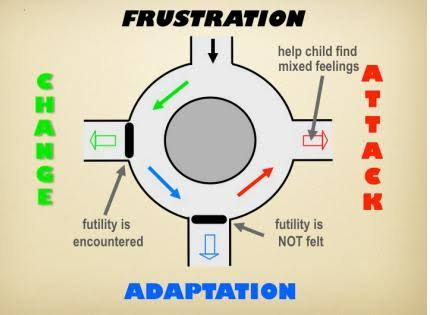
Dr. Gordon Neufeld’s Traffic Circle Model of Frustration
Since Neufeld works primarily with children and their families, a parenting example might express this model particularly well: Suppose your three-year-old begins to melt down because her favorite princess jammies are in the wash and unavailable for bedtime. She wants those jammies and simply cannot go to bed without them. Her frustration may move her to try to change the situation; she may continue crying, asking again and again for the jammies. If the parent communicates, kindly but firmly, that the jammies are not available, she may, in Neufeld’s words, “encounter futility.” Futility is encountered when a situation is not changing. The jammies have peanut butter on them and are soaking in the wash. The jammies cannot be worn, and there’s no way around it. Futility!
Here’s the very important part: There is a difference between simply encountering futility (hitting a roadblock) and feeling it (allowing the roadblock to sink in, and then grieving it). If the child can feel this futility, then their frustration can melt into sadness, then to acceptance and adaptation. Perhaps the little girl can finally feel it; she may weep, but not angry, energized cries. They may be softer, tears of grief. And if she has the space to grieve this, she can finally rest. Here, the frustration drive has reached its end goal of helping her accept the unchangeable and grow in the process (she now knows, deep down, that she can fall asleep without the princess jammies).
As seen in the traffic circle, if futility is not felt, frustration continues to cycle as one attempts to change the unchangeable, and they may become aggressive and angry when that continues to fail. In our little girl, if she doesn’t feel her futility, she may begin to stomp, hit, throw, and attack. There is something about unchallenged frustration that loops and escalates as it tries to accomplish its purpose. We cannot be at rest until we feel our futility.
Now, the example of the little girl exemplifies a situation in which the circumstances cannot be immediately changed, and she needs to feel her futility. We could cite many examples of frustrated energy moving one to solve problems and make changes. There are many situations where futility is not inevitable; very often, change can and should happen! Like the Serenity Prayer by Reinhold Niebuhr states, “God. grant me the serenity to accept the things I cannot change, courage to change the things I can, and wisdom to know the difference.” It takes wisdom to discern whether a situation can be changed, or if we need to allow our frustration to melt into grief.

Neufeld’s work is meant to educate parents to be that wise mind, helping their children discern this so that one day, they can do it for themselves. At our practice, we often draw on a client’s “Self energy”, which is calm, compassionate, curious, and wise, to lead the (sometimes childlike) frustrated “part” of a client around this traffic circle, just as a good parent would lead their child. If you can identify an area where a part of you feels frustrated, try this brief exercise:
Focus on this part of you that feels frustration. What does it feel like in your body? What does it say?
See if you can picture it sitting across from you at a table. You are here to get to know it, to befriend it. If you notice any other feelings towards it (for example, annoyance, overwhelm, or fear), ask those parts if they will give you space while you get to know this frustrated part of yourself.
If you can look upon this frustrated part with openness, curiosity, and compassion, see if you can hear its concerns and desires. Help it discern whether its frustrations can be fuel for change. Is this a problem that can be solved? Are you responsible for solving it? If so, help it to find a solution, even if it’s one small step.
However, your wise mind might be sensing futility here that the frustrated part doesn’t want to feel. Futility can be incredibly hard to face, and you can validate this. Could this part be feeling its limits and restrictions? The futility of unachieved fulfillment? The futility of trying to control others? If you sense this, just gently reflect it to that frustrated part. Notice if any feelings of grief or sadness arise. If they do, let them flow, recognizing that they are the beginning of important change and adaptation.
Helping discern the end goal of frustration is not an easy task, and one that is built for community. It is important to seek wise counsel from a friend, mentor, pastor, or therapist as you engage with your frustration. Allow someone to know this frustration alongside you and help discern how to guide this energy helpfully. Once frustration finds its right ends, either through problem-solving or adaptation, we can rest and grow.

Resources:
For a fantastic summary of the Traffic Circle Model of Frustration, see Dr. Neufeld’s 18-minute video: https://www.neufeldinstitute.org/editorials/the-untold-story-of-frustration-in-18-minutes
For this perspective translated into practical love for parents, see Dr. Deborah Macnamara’s book, Rest, Play, Grow.